Stumps & roots · 7 MIN READ
Stump Grinding Near Fences, Sidewalks & Houses
A stump sitting close to a fence, sidewalk, driveway, deck, or house may still be a good candidate for grinding. The real answer depends on how the stump has grown around the obstacle, what may be hidden inside it, how the equipment can reach it, and what you plan to do with the space afterward.
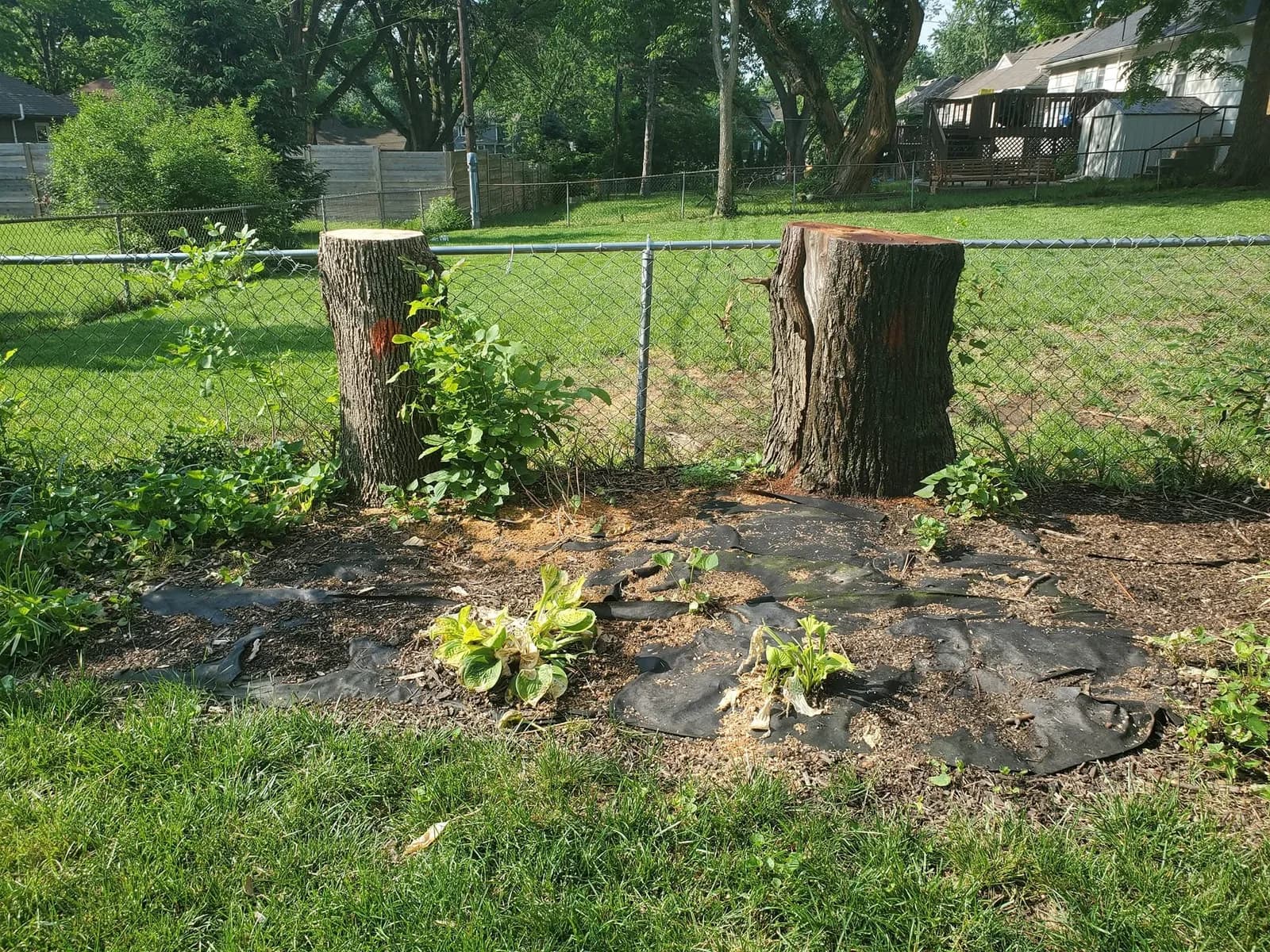
That is why a clear photo often tells more than a stump measurement alone. Before scheduling stump grinding in Johnson County, Kansas, show the full stump, the nearby structure, and the route through the yard. Those details help define what can be ground and where the operator may need to stop.
What changes when a stump is close to a structure?
A stump in the middle of an open lawn usually provides room to position the grinder and work around the base. A stump beside a fence or concrete edge can limit that working space.
Several details affect the job:
- The distance between the stump and the structure
- The direction and spread of visible roots
- The amount of open space around the stump
- Rocks, edging, wire, nails, posts, or other materials near the wood
- The route from the driveway to the work area
- Public utilities and private underground lines
- The final result you need for the area
Two stumps with the same base width can require different plans. One may be fully exposed in a lawn. Another may have grown around a fence post or beneath the edge of a sidewalk. A quote should account for the full setup, not just the diameter.
Stump grinding near fences
Fences can create two separate concerns: equipment access and material embedded in the stump.
First, the grinder needs a clear route into the yard and enough room to work. Open the gate fully and measure the narrowest usable point, including hinges, latches, posts, and tight turns. Heartland asks homeowners to show the entire route because the gate width alone does not describe every access issue.
Second, look closely at the stump itself. Trees growing along property lines sometimes surround old wire, fasteners, or fence posts. Do not try to pull hidden metal from the stump before it has been assessed. Send a close photo and a wider photo that shows how the fence meets the wood.
Grinding may still be possible, but the agreed scope will depend on how close the fence is and whether anything is embedded in the stump. In some cases, fence work or additional clearance may need to happen first.
Stump grinding near sidewalks and driveways
Roots often spread beneath or alongside concrete. Grinding can reduce the visible stump and selected exposed roots included in the quote, but it does not pull the entire underground root system from beneath the pavement.
If your goal is to improve mowing or remove a trip hazard beside the walkway, stump grinding may provide the result you need. If you plan to replace the sidewalk or driveway, ask that contractor what must be excavated before the new surface is installed. Grinding alone should not be treated as automatic preparation for concrete work.
Photograph cracks, lifted edges, surface roots, landscape borders, and the full width of the nearby pavement. This gives the stump grinding contractor a better view of the work area and gives your concrete contractor a clearer starting point for the next phase.
Stump grinding near houses, decks and foundations
A stump close to a house or deck needs a careful review of the available working space. The operator must consider the structure, nearby windows or siding, landscaping, and the angle needed to reach the stump.
Protective screens can help contain flying chips during grinding, but they do not remove the need for clear access and an agreed stopping point. A stump or root that runs directly under a foundation, footing, deck post, or other structure may limit how much material can be reached with a grinder.
Tell the contractor what must stay in place and what you plan to change. Removing a stump so you can mow the area has a different scope than preparing for a deck addition, retaining wall, or foundation project.
Public utilities and private underground lines
Visible obstacles are only part of the picture. Utility lines and privately owned systems may cross the work area.
Heartland arranges the public utility locate request before grinding. However, public utility locators do not mark every privately owned line. Sprinkler systems, invisible fences, septic components, landscape lighting, power to an outbuilding, and other private facilities may require a private locator.
Share anything you know about private lines when requesting a quote. Do not remove locate flags or paint before the job is complete. If you are unsure what an 811 locate covers, review the Kansas 811 guidance for homeowners.
Photos and measurements to send before a quote
You do not need to solve every access or clearance issue before contacting Heartland. Start by documenting the job clearly.
Send these views:
- The full stump: Include the entire base and visible roots.
- The closest obstacle: Show the fence, concrete, deck, wall, or other structure in the same frame as the stump.
- A close-up of unusual details: Capture embedded metal, rocks, wire, edging, decay, or joined trunks.
- The equipment route: Photograph the driveway, open gate, narrowest passage, turns, slopes, and steps.
- The area from farther back: Show how the stump fits into the yard and what surrounds the work zone.
Measure the widest part of the stump at ground level, including the flared roots. Add the stump height and the narrowest clear width along the access route. Heartland's stump measuring guide explains exactly where to place the tape and which photos help most.
Tell Matt what comes after grinding
Your next project helps determine the right grinding scope. Before approving the quote, tell Matt if you want to:
- Restore grass
- Create a planting bed
- Install or repair a fence
- Replace a sidewalk or driveway
- Build a patio, deck, shed, or addition
- Plant another tree or shrub
Stump grinding reduces the stump in place, while some underground roots remain. A landscaper, fence installer, concrete contractor, or builder may have additional excavation and site preparation requirements. Confirm those requirements early so each contractor understands where one phase ends and the next begins.
Learn more about what happens to roots after stump grinding as you plan the next phase.
Get a stump grinding quote in Johnson County
A stump beside a structure should be quoted with the surrounding property in view. Good photos, accurate measurements, and a clear description of your next step help prevent surprises and define a practical scope.
Heartland Stump Removal provides owner-operated stump grinding in Lenexa and throughout Johnson County, Kansas. Send Matt your stump measurements, photos, property address, and access details to get a quote for your project.
Frequently asked questions
Can a stump near a fence, sidewalk or house be ground safely?
Nearby structures affect how the work is approached. The contractor should review the clearance, root location, hidden materials, and working space before grinding. Protective screens and careful equipment placement help manage the work area, but some stumps may require a limited scope or preparation first.
Will I need to remove my fence before stump grinding?
Not always. It depends on gate access, working room, and whether the stump has grown around a post, wire, or other fence material. Send photos before removing anything so the contractor can explain what clearance is needed.
Can stump grinding remove roots under a sidewalk?
Selected exposed roots may be included in a stump grinding quote. Roots running under concrete are different because the grinder cannot reach through the pavement. Ask your concrete contractor what must be excavated if you plan to repair or replace the sidewalk.
Does a public utility locate mark sprinkler systems and invisible fences?
Public utility locators generally do not mark privately owned facilities. Kansas 811 lists sprinkler systems, invisible fences, septic systems, and power serving outbuildings among the private facilities that may require a private utility locator.
Read Kansas 811 homeowner guidanceWhat should I send when requesting a stump grinding quote?
Include the property address, the widest stump measurement at ground level, the stump height, photos of the stump and nearby structures, and photos of the route into the yard. Explain what you want to do with the space after grinding.
A useful next step.
You don’t need every answer before getting in touch. Start with your location, a few photos taken safely and what you’d like to do with the space.
See what this service includes